There is a growing sense both in Britain and abroad that standards of UK public life have fallen to an all-time low. In a recent speech, the former Prime Minister, The Rt Hon Sir John Major, stated:
If trust in our word is lost overseas, we may no longer be able to work effectively with friends and partners for mutual benefit – or even security. Unfortunately, that trust is being lost, and our reputation overseas has fallen because of our conduct. We are weakening our influence in the world.
And the Speaker of the House, Sir Lindsay Hoyle, felt obliged to remind MPs that, ‘our words have consequences and we should always be mindful of that fact’. This was in response to intimidating and threatening behaviour experienced by the Leader of the Opposition and Shadow Foreign Secretary following comments by the Prime Minister which were deemed inappropriate (though not disorderly).
What we are seeing today is the consequence of decades of under-investment in public administration education, professional development, and research. Where there have been innovative policy experiments, they have typically taken place without formal evaluation and valuable learning has been lost. The potential creation of a Government Campus and Leadership College for Government offers some hope but only if the lessons from the RIPA, the Civil Service College, and the National School of Government (all now closed) are taken on board.
I’ve been conducting interviews in my research for a very long time. And during that time the most laborious part of interviewing has always been transcribing. So, needless to say I was very excited when I discovered that Microsoft Word has a new function to automatically transcribe audio files!
All you need is an premium Microsoft Office365 account – it only works with the online version of Microsoft Word. Check out this short video which talks through how to use the feature.
I’ve already tested the feature and I was really impressed by how quickly the transcription took. Most importantly, I found that it was very accurate.
Have you tried this feature yet and did you find it to be accurate? I’d be really interested to hear your views.
This blog post was stimulated by a discussion I had recently on Twitter and LinkedIn about academic podcasts.
For some time now I’ve been a big fan of the Academics of PA podcast. This is a podcast hosted by Bruce McDonald (North Carolina State University), Josie Schafer (University of Nebraska Omaha) and Will Hatcher (Augusta University). In it they interview some of the most well known academics in public administration and public management (particularly from the US). It has been fascinating to hear about how others have developed their careers, some of the challenges they have faced and what they have learned as a result. It has been especially valuable to hear from prominent professors about issues related to work-life balance.
From my own perspective I have a real interest in podcasts that relate to my own subject of public administration and management. The above mentioned Academics of PA is a particularly good example of this. From a more practical perspective, and due to my own interest in Scottish public affairs, I also enjoy listening to Politically Speaking which is hosted by Mandy Rhodes, editor of Holyrood Magazine. Finally, although it is a YouTube channel as opposed to a podcast, Public Administration Xchange by Colin Talbot provides some excellent interviews with public administration academics and practitioners.
Given my interest in podcasts related to public administration and management I was delighted when Russ Glennon, from Manchester Metropolitan University, approached me about the potential for doing a podcast like Academics of PA but with a more UK slant on things. In the dark days of late 2020 this seemed like a terrific idea, being able to work with Russ and Karin Bottom (INLOGOV), having some fun chat, and building on what had been done by Bruce, Josie and Will. And so the idea of Public Service Podcasting was born.
In Public Service Podcasting we aim to spread the word about public administration and management scholarship. I’m super excited to be part of the team hosting discussions with some amazing academics from the UK and beyond. Our first episode will be launching soon – make sure to follow us on Twitter to find out more!
In public administration everyone is talking about collaboration, co-production, co-design, co-commissioning. But do public administration academics practice what we preach? In this post I want to briefly discuss some of the key findings from my latest research which is available for free download here: https://doi.org/10.1177/0144739420968862
In the various degree programmes and modules I have designed I have always tried to ensure that students are engaged in the design of the curriculum and that they benefit from a blend of professional experience and academic learning.
Typically this has been achieved through a range of learning activities such as fieldtrips, leadership exchanges, action learning sets, coaching and in-class sessions – many of which I have written about previously. It is important that throughout the learning experience students are engaged and empowered in order to make lasting change to the communities they serve. But it’s not enough to talk or read about this – I believe students need to experience it too. This is particularly important in public administration programmes.
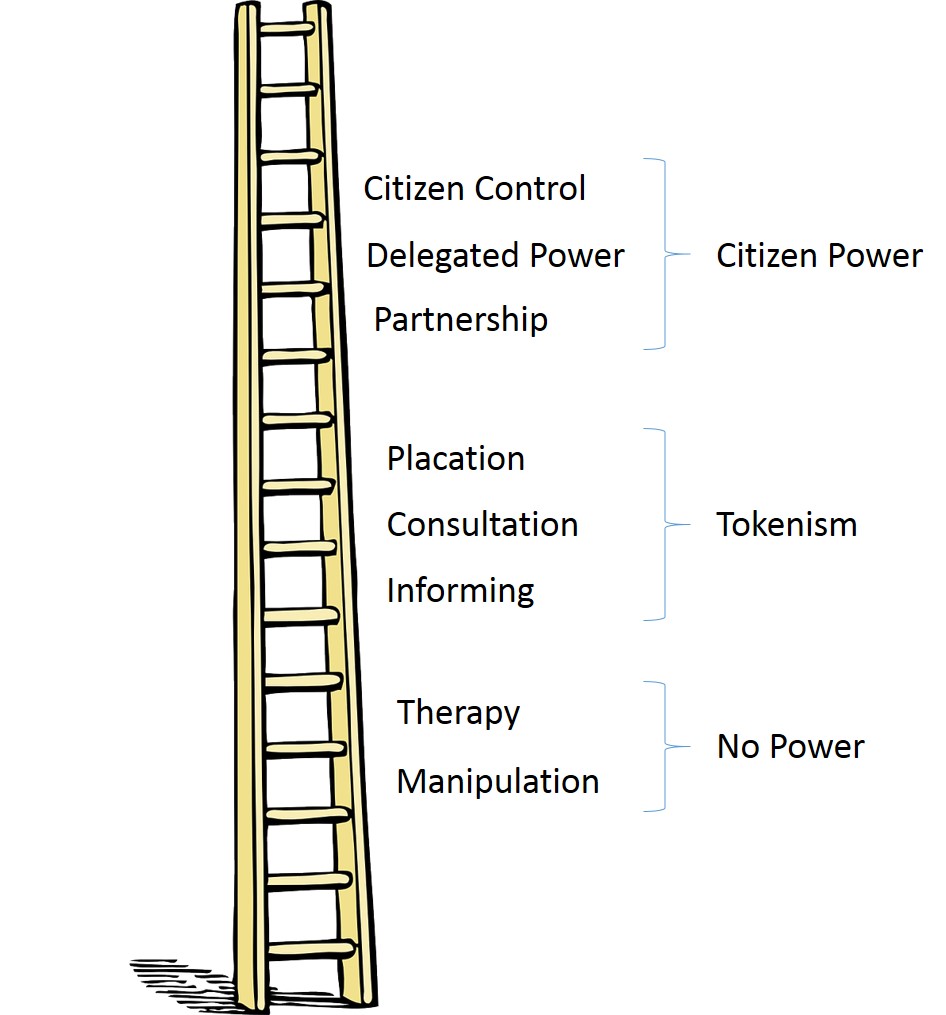
Thus it is important that public administration students have ownership of their degree programme(s) – and have ownership of improvement. Just as the communities they serve should have ownership and power to deliver improvements to their areas. This relates very much to Arnstein’s Ladder of Participation:
Students are not simply the passive recipients of knowledge – but they should have significant delegated power and control to make changes to their degree programme(s). There are a number of ways through which this is facilitated including through student-staff consultative meetings.
One exercise I have used for a number of years now is based around the concept of curriculum co-design. This has always generated lots of great ideas and discussion. During one such session a student, who was looking a little perplexed by the process said,
“I’m just trying to take it all in. It’s just so different to anything I’ve done before. All I can think right now is WOW”
Former student
That was a wonderful thing to hear. As academics we want to stretch our students (figuratively of course) and challenge their assumptions. This student was clearly expressing a sense of “liminality” – in between receiving and producing.
The use of curriculum co-design in the classroom is particularly beneficial in public administration programmes as co-production has become an influential practice in public services across the UK. In England this is part of a shift in how public services are designed and delivered through the localism agenda. Examples include the development of combined authorities and elected mayors. In Scotland co-production is one of the key pillars of the Scottish Approach to Public Administration as seen in community empowerment. This is part of a wider trend within public administration which has seen a shift from direct top-down delivery of services through to outsourcing and privatisation and now to increasing collaboration, coproduction and co-design of our public services.
It was my experience of using curriculm co-deshn in the classroom, and finding few examples of it being used elsewhere, that led me to reflect on this practice in this journal article:
Elliott, I. C., Robson, I., & Dudau, A. (2020). Building student engagement through co-production and curriculum co-design in public administration programmes. Teaching Public Administration. https://doi.org/10.1177/0144739420968862
Ian Robson (Northumbria University) and Adina Dudau (University of Glasgow) worked with me on the article, helping with my auto-ethnographic reflections and in writing the final piece. I am delighted to see this now available for free Open Access via Teaching Public Administration and that it will feature as part of a special issue edited by John Connolly (University of West of Scotland) and Alice Moseley (University of Executer) on “Curriculum Design in Public Administration Education: Challenges and Perspectives”.
In our article we conclude:
I must thank all those involved in development of this article including students, reviewers, my co-authors and the special issue editors. Hopefully this represents a good example of collaboration and co-production that will stimulate further debate on public administration pedagogy for years to come.
So said the UK Prime Minister recently in a call to Conservative MPs according to news reports. This comment has sparked considerable debate over the relative successes or merits of Scottish devolution and the growing calls for a second independence referendum.
I’ve spent the last twenty years or so researching issues of public management and administration. More recently I have focused on aspects of public services in Scotland including health and social care integration, community empowerment and the Scottish Government. Given the current discussions over what the UK Prime Minister is reported to have said I thought it might be useful to consider some of the evidence.
Scottish devolution has led to increasing policy divergence from the rest of the UK (rUK). This has created some challenges and tensions within the devolution settlement itself; for example, in Scottish higher education (which is devolved) the Scottish Government continue to provide free education to Scottish students but many other aspects of policy which also affect Scottish universities (such as immigration policy, REF and research funding) remain under the auspices of the UK Government (reserved powers). This, as with many other tensions in the devolution settlement, is becoming increasingly sensitive as the impact of Brexit becomes clear and debates continue around use of the Sewel Convention.
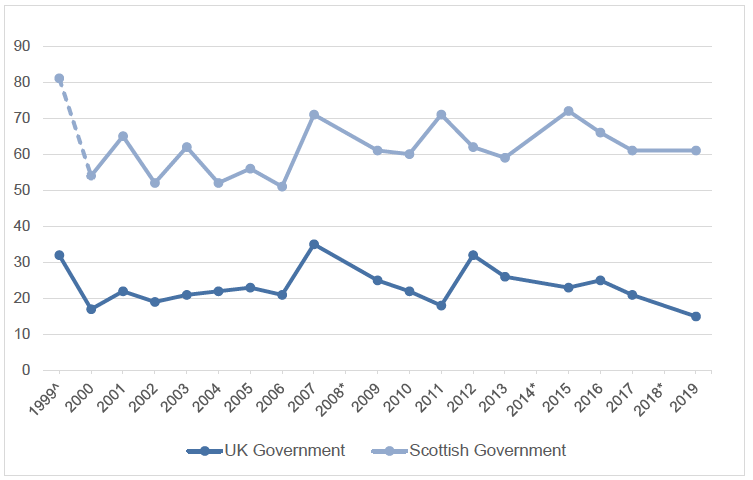
In my research I have shown how the Scottish Government have, since devolution, developed a more strategic approach to governance. The evidence I have collected through my studies suggests that this has made a positive difference to the inner workings of the Scottish Government. Further evidence shows how confidence in the Scottish Government remains high. Trust in the Scottish Government has fluctuated between just over 50% in 2006 (directly before the development of the strategic approach) to 72% in 2016.
Figure 2.1: Trust in Scottish Government and UK Government to work in Scotland’s best interests ‘just about always’ or ‘most of the time’ (1999-2019)^
There are also a number of polls and surveys which indicate high levels of popularity and approval for Nicola Sturgeon and for the Scottish Government – particularly in how they have handled the Covid-19 crisis. It is hard to see how this would be possible without a competent and well functioning administration.
What remains less clear is the extent to which these changes have had a positive impact on the daily lives of the people of Scotland. For example, a different approach has been adopted in with community empowerment it remains unclear how effective this policy has been in practice. Equally cuts to local government have created significant pressure and adversely affected the working lives of those who deliver these vital services.
The fact remains that there simply isn’t sufficient evidence to either support or rebuke the claims of the UK Prime Minister that Scottish devolution has been a disaster. One of the biggest challenges here is the general lack of academic research. Of course there is some excellent research on public policy and administration taking place in Scotland. My point though is that there are relatively few public administration scholars or university departments in Scottish universities.
Assuming we consider the teaching of public administration as a barometer for the health of the subject. Previously there were many departments of public management and administration in Scottish universities and many degree programmes. Currently there is only one Master of Public Administration (MPA) programme in Scotland and no undergraduate degrees in the subject. Taking a comparative approach, in the US states of Minnesota and South Carolina, which both have comparable population size to Scotland, there are 6 and 5 Master of Public Administration (MPA) programmes respectively. Does it follow that there are more public administration scholars across the US and therefore more public administration research taking place? I think so.
Pressures to publish internationally relevant research and to generate income from degree programmes have arguably contributed to a steady decline of public administration scholarship in Scotland (and indeed across the UK). The consequence of this is that there is a relative lack of independent data with which to explore the impacts of devolution over time. There is also arguably a lack of development of future public administration leaders and managers (including in comparison with rUK).
Has devolution been a disaster? My research would not support this statement. But if Scotland is to gain further devolved powers, or even full independence, we need more academic research in Scottish public administration in order to continue to address this question.
I have previously written about Why Do a PhD? and How to Prepare for your Viva. But the final examination of doctoral research is based on both the written work (the thesis) and the performance of the student at the viva voce (verbal examination). So what is the motivation for examining a doctoral thesis? How does an examiner go about examining doctoral research? How does an examiner prepare for the viva? And how do they go about reaching a final decision on the quality of the work?
For every examiner this may be different. However, from my perspective I thoroughly enjoy examining doctoral research. I find it to be a great opportunity to learn about the most current research and to discuss this with an emerging scholar. I also want to help the researcher to improve the work and ensure that it is the best that it can be. Ultimately, I am on your side.
In examining a doctorate I will read the thesis thoroughly, making copious notes, and thinking about areas of the thesis where I will want to focus within the viva. By the time I have finished reading the thesis I will have made a judgement about the quality of the research – but it is then important to gain an understanding of the motives and learning of the researcher.
By the time it comes to the viva I will have read the thesis at least twice and will have lots of notes to guide my questions. Typically I will start by asking about the student’s experience and their motivations for doing the research. I may want to know more about the decisions that were made around choice of methodology and methods or how the theoretical focus of the research has been arrived at. Overall I will be exploring the researchers motives and their competence as an independent researcher. I will also want to know what they might do differently if they were to do the research again – what has the researcher learned through the process and are they able to critically reflect on their own practice as a researcher?
Overall I want to make sure that the research can be as good as it can be. It’s important to remember that, by the time you come to submission of your thesis and the viva, the researcher will have engaged in lots of peer review and formative assessment of their work. This may be by presenting at academic conferences, by getting feedback from their supervisors, or through their annual review(s). I will be assessing both the written work and the performance in the viva. As such it is important to prepare for both. What I’m looking for is to see the researcher as a potential future colleague – as a peer.
Remember – I am interested in the research, I want to learn about what has been done and I’m really looking forward to the viva conversation.
This is a brief summary of my research on organisational learning and change as published in Teaching Public Administration in February 2020.
In this article I spoke to a wide range of public sector managers about their experiences of being involved in a public leadership degree programme. I was interested to know what they saw as being the benefits of this learning experience and how it had influenced their practice.
In this article I discuss the nature of the budget cuts that took place across public sector organisations and particularly how learning and development budgets were seen to be an easy target. I then discuss how the participants had encountered barriers to change and what they felt needed to happen to enable innovation and change.
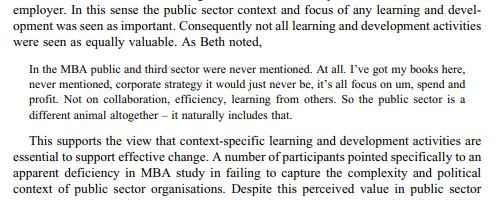
One aspect highlighted was the extent to which it was seen as important that any learning and development was sector specific as the following extract highlights:
More research related to learning and development in public service organisations can be found here:
Gibb, S., Ishaq, M., Elliott, I.C. & Hussain, A.M. (2020) Fair and decent work in Scotland’s local authorities: evidence and challenges, Public Money & Management, DOI: 10.1080/09540962.2020.1723262
Elliott, I.C., Sinclair, C. and Hesselgreaves, H. (2020) “Leadership of Integrated Health and Social Care Services”, Scottish Affairs, 29 (2): 198-222. DOI:https://doi.org/10.3366/scot.2020.0316.
Coronavirus, or Covid-19, has dominated the news headlines for most of 2020. It has affected every country, every community, everyone. The impact is likely to last for years. What can academia offer in the face of this global public health disaster?
I was honoured to be included, in my role as PAC Chair, in the below discussion on the UK Government response to Covid-19 earlier this year.
Following this discussion the co-editors of our esteemed academic journal, Public Policy and Administration (PPA), have set out seven key research themes where PPA scholars may contribute to our wider understanding of Covid-19. These are published in the October issue of PPA and available online now (Dunlop et al. 2020).
Dunlop, C. A., Ongaro, E., & Baker, K. (2020). “Researching COVID-19: A research agenda for public policy and administration scholars”. Public Policy and Administration, 35(4), 365–383. https://doi.org/10.1177/0952076720939631
Over the next few weeks I will be developing a number of resources on research methods to support some of my teaching. Given the impact of the COVID-19 pandemic many of these resources will be about online research methods. I am adding them here so they are publicly accessible for anyone else to use.
This Twitter thread highlights a number of references relating to online qualitative methods.
As an ethics committee, we have produced COVID-19 guidance for students doing empirical projects. For many it will require suspending data collection, moving to online platforms, or redesigning projects. Here are some resources & examples for qualitative projects (1/n)
I added the author, Gary Bandy, into one of my comments in the thread and after some more discussion Gary kindly agreed to do a short recorded video with me. Unfortunately my webcam cut out half way through the interview. Clearly our tech is going to be challenged over the next few weeks!
This video interview is listed below.
Gary has a number of other online resources including an online school which can be found at https://courses.managingpublicmoney.co.uk . This includes a number of free resources including the free 5 questions to ask about your budget at http://bit.ly/budget5q
Over the last few days I have been developing resources to support online delivery of my modules. As the restrictions on travel continue we will need to do more to support each other via online platforms. If there is anything you think I could help with do get in touch – we need to work together more than ever right now and I’d be very happy to help.










 Dr Ian C Elliott