Category: Public Services Governance

  • Coffee, lunch, education, networking, experience, trip to Brussels!

    Coffee, lunch, education, networking, experience, trip to Brussels!

    EU Referendum, elections for the Scottish Parliament, Welsh Assembly, Northern Ireland Assembly, English local councils, London Mayor and London Assembly, police and crime commissioner elections. May 2016 is due to be a busy month for all of those with an interest in Politics, Policy and Public Administration. At a global level the development of the UN’s Sustainable Development Goal’s and the Paris Agreement on Climate Change represent major challenges for all those working in public service contexts. All of this means that the next few weeks and months will undoubtedly involve a degree of change for our public services.

    At QMU we are bringing together some of the top thinkers in public administration for a research colloquium on Friday 13 May 2016 in order to contribute to ongoing debates around the successful leadership of change in our public services. Attendance for delegates is FREE as this event has been kindly sponsored by the Joint University Council’s Public Administration Committee (of which we are an institutional member).

    Spaces are limited so please book now to reserve your place: https://www.eventbrite.com/e/leading-change-in-public-services-tickets-24921644309

    Confirmed speakers include Prof Paul Cairney, University of Stirling, Scotland, Prof Paul Joyce, Universite Libre de Bruxelle, Belgium, and Prof Jari Stenvall, University of Tampere, Finland. As well as learning about the latest academic research delegates will benefit from some key insights into professional practice from Dave Watson, Head of Policy & Public Affairs at UNISON Scotland and Steve Toft, Director of Crucible and writer of Flip Chart Fairy Tales. A full draft agenda is available here.

    Following this conference we will be publishing a short report and speakers will be invited to contribute to a special issue of a peer-reviewed academic journal.

    This FREE event is just one example of the type of learning experience that can be expected by students on our new MPA programme. We always endeavor to build the research base of our teaching and engage with policy and practice. By doing so we can assure that our postgraduate programmes are context-driven and problem-focused.

    Previously we have also been able to offer our students free places at other professional conferences. We also have a number of great guest speakers (though this does not include Donald Trump!).We are also able to offer free tuition through a number of scholarship schemes and tuition fee loans from SAAS. There are also SAAS living-cost loans up to £4,500 available to cover living expenses while studying. Other scholarship information is available here. We will also be offering free workplace learning opportunities to all students on the programme in association with ACOSVO. And, we are able to offer tuition fees at a reduced rate as this is a new programme.

    As well as offering extensive support to our students we are also able to offer an excellent student experience. The following short video illustrates some of the benefits of being a QMU postgraduate student. We are also current planning excursions and fieldtrips for our new MPA students including a trip to the Scottish Parliament and to the EU Parliament in Brussels.

    As well as all this we have recently validated a Professional Doctorate in Public Administration (DPA) whereby students from the MPA will have the opportunity to transfer over to the DPA after having completed six modules (and meeting other entry criteria). More on this later!

    We are keeping student numbers on our new MPA low in order to be able to provide an excellent student experience so to reserve a place on the programme please apply now: http://www.qmu.ac.uk/courses/PGCourse.cfm?c_id=277

  • ACOSVO Leadership Exchange

    ACOSVO Leadership Exchange

    As part of our new MPA programme we have developed a partnership with the Association of Chief Officers of Scottish Voluntary Organisations (ACOSVO) to include a practical experience opportunity for our students. For some of our students this will involve participating in ACOSVO’s highly innovative Leadership Exchange programme.

    In order to gain some first hand experience of this programme – and to develop my own professional practice – I took part in a leadership exchange over the last six months. The following is offered as a reflection on my participation.

    I was paired with Andy Dey, Operations and Development Manager at ACOSVO. The purpose of our exchange was largely to explore the links between our two organisations and, for me, to get experience of the Leadership Exchange prior to it becoming a core part of our new MPA programme. This last point was important as I wanted to make sure I had a concrete understanding of the process before advising our new students. But equally the former purpose was necessary so that we could scope out together how our two very different organisations would work together in supporting students on the MPA.

    The first thing to note about my particular exchange was that, as exchange partners, we could not be more different in our backgrounds and experience. Andy has experience at a senior level in the military (RAF/Air Commodore) and third sectors, including the running of multi-million pound, multinational organisations. I am an academic (albeit I do work in the real world!).

    This difference was not a barrier to learning. In fact, I would argue that having people working together from different organisations and backgrounds is an enabler of learning. What is important for learning to take place is that both parties are open to the opportunity and are willing to challenge and question their own practices, values and beliefs. In doing so it’s important that both parties in the exchange respect the others’ perspective. I’m reminded of my favourite Rabbie Burns poem, To a Louse,

    O wad some Power the giftie gie us
    To see oursels as ithers see us!
    It wad frae mony a blunder free us,
    An’ foolish notion:
    What airs in dress an’ gait wad lea’e us,
    An’ ev’n devotion!

    With any learning or development opportunity it’s important that those engaged in the process enter into it with the right mindset. If one party approaches any learning opportunity thinking ‘I know best’ then realistically there won’t be much learning!

    So whilst the exchange partners may come from different backgrounds and experiences it is important that they share a common purpose. Thus the first stage in the ACOSVO leadership exchange process, filling out the application form, includes questions such as:

    • What are your areas of experience and knowledge which might be of interest for an exchange partner?
    • What topics would you like to explore during your exchange?
    • What would you like to gain from a Leadership Exchange

    Within our MPA programme we are extending this by requiring students to complete a Tripartite Agreement between the university, their exchange partner and themselves. This will detail their anticipated learning outcomes from the exchange and the types of activities that they will be involved in to achieve these outcomes.

    Within my exchange the key outcomes were clear and were shared between myself and my exchange partner so that the experience was a positive one. We met a number of times at both ACOSVO and at the university. I was able to sit in on an ACOSVO board meeting and Andy contributed to one of our Collaborations Operations Group (COG) meetings. As well as our meetings we had regular email communications. Again, communication is important for any learning experience to work – not to mention partnership working.

    For our MPA students there will be a requirement that they attend four campus-based sessions about the workplace learning element of the programme. For those going through the leadership exchange there is a requirement that 24 hours of ‘contact time’ be used within the Leadership Exchange itself. This might equate to six half day (4 hour) sessions or three full day (8 hours) sessions. Again there needs to be this level of commitment and engagement in order to get the most out of it – particularly when benchmarked against Master’s level learning outcomes.

    But what did I get out of it? A greater appreciation of the great work done within the Third Sector; positive affirmation that what we do as a university in terms of governance and quality assurance is of a very high standard; and contact with a hugely experienced Third Sector leader – who also happens to be a great guest speaker! But most of all I would say that my experience on the leadership exchange made me realise just how great the idea of leadership exchange is – and the case studies from others who have taken part testify to the value of this programme.

    I would recommend the ACOSVO Leadership Exchange programme to anyone who genuinely wants to develop their professional practice. I’m delighted that at least one of my colleagues from the senior management team at QMU has embarked on a leadership exchange having heard about my experience – hopefully others will follow. Moreover I know that the MPA programme will be a terrific learning experience for all involved and I can’t wait to get started in September!

    Applications for our new MPA, in partnership with ACOSVO, are now open. Click here to apply.


  • Fat Cat Salaries and Gold-Plated Pensions

    Fat Cat Salaries and Gold-Plated Pensions

    Much of the popular press would have us believe that working in the public sector goes hand-in-hand with ‘fat-cat’ salaries (see here; here; and here), gold-plated final salary scheme pensions (here and here) and a job for life. In this context one might wonder why anyone would want to work anywhere else! Yet as this article by The Guardian demonstrates, these sensationalist headlines do not reflect the reality of the vast majority of public sector workers. Indeed, as the Full Fact website concludes,

    The Office of National Statistics report actually notes many of the caveats raised by the unions, however much of this important context has been lost in the media reporting on the issue. Far from conclusively reporting the relative pay of workers in the private and public sectors, the ONS report seems to ask more questions than it answers.

    So what are the benefits of working in the public sector? Indeed, are there any benefits at all?

    1. It is hard

    Working in the public sector is, in my opinion, harder than working in the private sector. Now let me qualify that statement. I don’t mean that all those who work in the public sector work longer hours or put in more effort over the average day than those who work in the private sector. But it is more difficult in the sense that measures of success are more difficult to define (and can shift over time). In the private sector, again to generalise, the measure of success is profit and the ultimate boss is the shareholders. In the public sector there are many different stakeholders including politicians (sometimes from opposing political parties), voters, the general public and service users – all of whom may have competing priorities in terms of what they perceive as being success. So, in other words, the public sector is more complex and linked to this efficiency savings are harder to achieve. How is this a benefit? Well, some people may quite like a challenge! At the same time it means that typically no two days will be the same and working with multiple groups of stakeholders, including international agencies, national governments and the general public, can be hugely rewarding in its own right.

    2. It is not well paid

    Again, it might seem counter-intuitive to highlight poor pay as an advantage of working in the public sector. To clarify, what I am referring to here is that there is comparatively poor pay in relation to equivalent jobs in the private sector. This has been demonstrated in ONS data, as referred to in this report by The Guardian, which shows that those with a degree or equivalent earn less in the public sector than in the private sector. So, if you are motivated by financial rewards, the public sector is most definitely not for you. People who work in the public sector tend to be motivated by, what has become known as, public service motivation (PSM). This explains how many of those who work in the public sector do so, not because of the personal benefits that accrue from this employment, but because of the social value of these jobs. Significant research has been conducted into the nature of PSM (see Perry 1996Perry, 1997;  Crewson, 1997;  Houston, 2000Wright et al., 2013Desmarais and Gamassou, 2014; and Ritz, 2016). Although different definitions abound, originally PSM was seen to involve: attraction to public policy making, commitment to the public interest, civic duty, social justice, self-sacrifice, and compassion. These are the real benefits of working in the public sector.

    To put it another way, we should consider this, across the UK more than 5 million people are employed in the public sector. In Scotland 20.9% of the workforce is employed in the public sector. That does not include the significant numbers of people who work in private and third sector organisations delivering or supporting public services. Those people do not work in those roles because they are easy or well paid. People choose to work in the public sector because they believe in public service values and they believe in the potential of public services to improve the lives of the most vulnerable in our society and support thriving and sustainable communities. What other reason do you need?


    This blog is an extended version of an interview which appeared in Prospects Magazine.

  • National Maternity Review and Public Service Vouchers

    National Maternity Review and Public Service Vouchers

    On Wednesday 2 March 2016 I appeared alongside Baroness Cumberlege; Professor Jon Glasby, University of Birmingham; Professor Henk Nies, University of Amsterdam and David Walker from The Guardian on the Radio 4 Money Box programme. This was to discuss Personalised Budgets in light of the National Maternity Review conducted by Baroness Cumberlege which proposed the trial of personalised budgets in maternity care.

    The full programme can be accessed here:

    https://uwhisp.com/embed?whisp_id=145045

    Needless to say it was quite a daunting experience being on radio for the first time and being alongside such eminent guests. What made it more peculiar was being inside, what I can best describe as a cupboard, at the Edinburgh BBC studios whilst others were either pre-recorded or live from London or Birmingham. The professionalism of all the technical staff, producers and the presenter, Lesley Curwin, to pull this all together and cover so much in a 30 minute programme was certainly impressive.

    img_20160302_143139.jpg

    Picture: BBC Studio, Edinburgh.

    My involvement on this programme was primarily due to the nature of my PhD research which was specifically on ‘Barriers to the Implementation of Opt-Out Vouchers for Public Leisure Services’. In other words, what I looked at during my PhD included:

    1. The nature of public service vouchers and how they have been used in practice in education, housing and health services (particularly in the US where their use is prevalent);
    2. Circumstances where they can be used and where their use is more problematic;
    3. In a public service where their use would (according to theory) be least problematic (public leisure services) why this particular innovation has not been trialled more widely.

    It is difficult to summarise this in one blog post (the original thesis was 667 pages long over two volumes) and as a result this is a rather long post – and even then does not go into significant detail. For more information there are some references provided at the end of this post.

    In the context of ongoing reforms within health and social care my research is relevant as the nature of personal budgets are, in effect, a form of public service voucher. So what exactly is a public service voucher?

    Public service vouchers are

    publicly directed consumption with individualised choice of production and payment” (Valkama and Bailey, 2001: 54).

    Anything that extends choice and enables the user to have direct control over their budget is, in effect, a voucher scheme. Successive governments have chosen to avoid this language as the voucher concept has become so politicised but there are in fact many types of voucher scheme in existence in the UK (and internationally). The latest example of this is in the form of the proposed changes to maternity care which include the idea of trialling personal budgets for maternity care, including child birth. The author of this review, Baroness Cumberlege says “why don’t you have a go at this?” Let me explain why.

    Voucher systems can and do work. There is a range of evidence on their use in housing, education and health. There are two things we must look for when considering whether a voucher system is more or less appropriate:
    1. How complex is the service? (i.e. low transaction costs)
    2. Are there widespread and legitimate choices? (i.e. heterogeneous preferences)

    So, with certain social care services, for example, the actual service itself may be easy for the service user to assess; it may be something that they receive regularly; and there may be a range of service providers available. Consequently vouchers can offer greater choice and voice to the user. They can also perform a range of political purposes by being, for example, redistributive by being means-tested or targeted at specific groups.

    With many maternity services, and particularly with child birth, the characteristics  that we would look for to assess the viability of a voucher system simply do not exist. We can consider these in turn:

    1. Widespread and legitimate preferences

    The evidence shows that people do value choice in relation to health care. However, this depends, in part, on the question being asked. 75% of people want some say in the hospital where they are treated but only 22% support the idea of private businesses running hospitals. What’s more, when people are given the choice of either more personal choice or a better standard of care for everyone they are significantly more likely to support the latter.

    2. Individuals must have incentives to shop around

    It’s not clear why people would have an incentive to shop around for maternity care.  Another concerning aspect of the proposal is the idea that use of a voucher system could incentive efficiencies. When Baroness Cumberlege was interviewed on the programme she insisted that cost cutting was not a part of the impetus for this proposal yet the content of her own review highlights that,

    The payment system for maternity services should be reformed so that it is fair, incentivises efficiency and pays providers appropriately for the services they provide”.

    So it remains unclear to what extent efficiencies and cost savings are a part of this proposal. What’s more, innovation costs money and offering more a more bespoke service costs money. The Baroness admitted as much and Professor Nies was able to confirm that similar schemes in the Netherlands have ended up costing more money.

    3. Individuals must be well informed about the market

    This is where the area of health becomes particularly problematic in terms of use of choice. The review document states,

    They may need to look at alternative and innovative providers such as midwifery practices and social enterprises to provide genuine choice for their community

    The focus here seems to be on incentivising new providers into the market in order to meet the primary goal of being able to offer choice. Yet how informed will individuals be about the market. How certain can anyone be that a newly formed social enterprise offering child birth and maternity services today will still be in operation in nine months time?

    4. There needs to be a range of suppliers to chose from or low start-up costs

    There may be a range of suppliers in some areas such as large cities but choice will always be limited in more remote areas. Also most health services are complex and there are significant start up costs which will always limit the amount of competition available. It is noted in the review that all providers would be subject to the governance and oversight of the NHS which again is (rightly) going to limit competition.

    5. Service users must be able to assess quality

    It is very difficult to assess maternity care in any reliable way. Often it is only after the birth of a baby that any parent will be able to say whether they received a satisfactory level of care. At that point it is too late to exercise your consumer choice and go elsewhere. Similarly it is difficult to assess maternity services nationally – and any attempts to do so are likely to encourage perverse behaviours by providers by, for example, refusing to take high risk cases in order to look better on any league table of performance.

    6. The service should be relatively inexpensive and purchased frequently so people can learn by experience.

    Again this is a major issue with any health service. Typically these services are not cheap. And does anyone want to go with the cheapest option when it comes to child birth? What is more (as noted above), these are one-off events. Yes, if you have a bad experience with the care you receive during child birth the first time around you may well choose differently if you have another pregnancy. But in the moment of child birth choices are naturally limited.

    In summing up the experimentation with alternative forms of maternity care Baroness Cumberlege stated:

    Now the tariff is in three different sections and first of all it is for standard care which is low risk and then it is for intermediate care and then it is for complex care. And so it varies according to the care you need. We are saying to the commissioners, the GP commissioners who are buying services ‘why don’t you have a go at this?’

    There are in fact many positive aspects of the National Maternity Review and it recognises the importance of quality of care within these services. But in terms of the use of vouchers all the above highlights the economic arguments against their use for maternity care – and specifically child birth. There are also important managerial and ethical considerations which should be taken into account before such a system is trialled. In particular we might ask whether it is appropriate to base decisions of maternity care and health policy on the grounds of ‘why don’t you have a go’.

    Part of my ongoing research is looking at the leadership of change and innovation within public service contexts. Queen Margaret University are hosting an event on this very subject on Friday 13 May 2016. There are specific circumstances within public service environments where innovation may not be appropriate and others where it is. The trialling of voucher systems as a funding mechanism for maternity services may be a step too far.

    Further sources:

    Valkama, P., Bailey, S.J. and Elliott, I.C. 2010. “Vouchers as Innovative Funding of Public Services”. In Bailey, S.J., Valkama, P., and Anttiroiko, A. (Eds) Innovations in Financing Public Services: Country Case Studies. Palgrave Macmillan.
    Elliott, I.C., Valkama, P. and Bailey, S.J. 2010. “Public Service Vouchers in the UK and Finland”. In Bailey, S.J., Valkama, P., and Anttiroiko, A. (Eds) Innovations in Financing Public Services: Country Case Studies. Palgrave Macmillan.
    Elliott, I.C. 2008. “Making Space or Enabling Use: The Case of Opt-Out Vouchers for Public Leisure Services” in Gale, T., Curry, N. and Hill, J. (eds) Making Space: Managing Resources for Leisure and Tourism. Leisure Studies Association.
    Bailey, S.J. 2003. Strategic Public Finance. Palgrave Macmillan.
    Bailey, S.J. 2001. Public Sector Economics: Theory, Policy and Practice. 2nd Edition. Palgrave Macmillan.

  • Academics in the Real World

    Academics in the Real World

    I’m often asked if I have any real world experience. Sometimes I’m even told ‘what would you know about the real world’. There are so many flaws in both those standpoints (and much has been written about this previously) but I think there is another important point to consider. What is happening here, is that there is a perception that universities, and by extension those who work in them, are somehow different from everyone else. That we are not ‘real’.

    The fact that, in Scotland over 56% of the population attend university has seemed to have been ignored. University education is for all – all ages, all backgrounds, anyone with a thirst for learning. It’s not some distant or exclusive ivory tower. We’re a’ Jock Tamson’s bairns – even academics.

    But more than that, I believe that everything we do in universities, has some form of practical focus and thus some basis in ‘reality’. One of my favourite quotes is by Kurt Lewin (1951):

    “There is nothing so practical as a good theory”.

    To develop any theory we may conduct experiments, collect surveys or observe communities. Then, when we then want our research to have an impact, again we are drawn to working with external organisations and professionals. Whatever the methodology, whatever the subject matter and whatever the impact there is always an external motivation and focus to our work.

    For me this is absolutely critical – and the idea that ‘practical’ and ‘theory’ are diametrically opposed is utter nonsense. Yes, theory may not always work out the way we had hoped or anticipated, but that is not to say that it doesn’t matter. One of our students, who is Head of Policy, Performance and Development at Anytown Council, summed it up by saying about our postgraduate programme that,

    “[This course] covers very contemporary and relevant issues – which aids the application of learning into the practical work environment. A good level of engagement with academic literature and research enhances this further. In a very time-constrained work life there is value in this course and I have not regretted my investment of time (which isn’t always the case!!)”.

    In other words, theory enhances practice! In my own work I have been fortunate to work with many external organisations. I have delivered a PgCert to public servants on behalf of Academi Wales and I’m currently supporting delivery of an MSc Public Services Leadership to City of Edinburgh Council, Dundee City Council and Orkney Islands Council.

    Recently, I have been involved in developing a new MPA programme. Again we wanted to make sure there were strong links with appropriate external organisations. As a result we have set up a partnership with the Association of Chief Officers of Scottish Voluntary Organisations (ACOSVO) to enable all students on our MPA to take part in some form of work experience while studying. This is a fantastic opportunity for students to see the links between theory and practice first hand.

    We are offering this MPA to individuals and to organisations. And we are always keen to work with external organisations to support employees and to inform the delivery of excellent public services. What’s more, we have arranged a special discounted fee level for this programme for it’s first year. But does the ‘real world’ want to work with us? Well, assuming that’s where you are right now – let me know!


    This post is also listed on LinkedIn where there have been a number of very interesting comments posted about the extent to which those working in universities can support those in other public services. This can be viewed here: https://www.linkedin.com/pulse/academics-real-world-ian-c-elliott

  • Call for Abstracts – Leading Change in Public Services

    As reported last week someone has finally claimed the second outstanding Lotto prize of £33m. That’s a lot of money! Certainly more than I can imagine. But what about £107m, £100m or £46m?

    These are the amounts of money that Edinburgh, Glasgow, and Highland Councils respectively have to save over the next five years, two years and three years. That’s like winning the Lotto multiple times. Or you might say, it’s like waiting for a miracle to happen.

    But in this case there is no waiting. Change must happen now. But how do we lead change in public service organisations? That is the topic of a research colloquium being held at Queen Margaret University, Edinburgh on Friday 13 May 2016.

    More than ever before, our public service organisations need evidence on how best to deliver sustainable change. Therefore we would like to invite abstracts from interested participants for presentation at this colloquium.

    To contribute, please submit your abstract to events@qmu.ac.uk. Abstracts should be no more than 500 words (excluding references), written in English, single spaced, plain text and with no tables or figures.
    All reasonable travel and accommodation costs will be covered for confirmed speakers. You should contact events@qmu.ac.uk prior to any booking in order to confirm costs.

    The full Call for Abstracts is available here.


  • What is an MPA?

    What is an MPA?

    NB: This was originally posted in 2016. As of September 2018 I no longer work at Queen Margaret University. As such some of the links on the below post may no longer work. For information about my current post please go to the About Me section of this website.

    By Dr Ian C Elliott, Dr Peter Falconer and Susanne Ross

    What on earth is an MPA? Is that similar to an MBA? Why would anyone want to do an MPA? These are just some of the questions we have been asked when speaking to public service professionals about the development of the MPA at Queen Margaret University.

    So what is an MPA? Well, to start with, it is a Master of Public Administration. In other words, it’s the public sector equivalent of a Master of Business Administration (MBA).

    In that case presumably it must be similar to an MBA? Well, yes and no. The MPA and MBA are what are known as Type 3 master’s programmes – in other words, post-experience master’s. Entrants to this type of programme would typically have at least two years experience. In this sense the MBA and MPA are similar – both are typically post-experience master’s programmes. But the MPA programme may be of interest to anyone motivated by public service rather than commerce.

    But is the content of an MPA similar to an MBA? This is where things start to get more complicated. There is no single set curriculum for MPA programmes. As a result some (though not all) MPA programmes have content that is very similar to what you would find on an MBA. Modules can include things like strategic management in the public sector; human resource management in the public sector; financial management in the public sector and so on. In other words, an MBA with a public sector slant.

    So why would anyone want to do an MPA? Increasingly there is a recognition that private sector management techniques do not always translate into public service environments. Different skillsets and different perspectives are needed to transform public services. Those with professional experience will likely have significant management skills already. Studying an MPA, as opposed to an MBA, can help develop new skills and new perspectives.

    The QMU MPA in Edinburgh is structured around a philosophy of transformational change. In designing the curriculum our starting point was to consider what makes public services distinctive – their central role in promoting social justice and equality. Modules include ‘Gender and Equality’ alongside ‘International Trends in Public Administration’ and ‘Leading Change in Public Services’. Rather than reflect public services, the State and society, this MPA programme aims to shape the public service landscape of tomorrow.

    If that is something you can relate to then this might just be the MPA for you. Further information is available in this programme leaflet or at our website. For more information contact the MPA Director, Dr Ian C Elliott: ielliott@qmu.ac.uk

    Dr Ian C Elliott, Senior Lecturer in Business & Public Services, QMU Edinburgh.

    Susanne Ross, Lecturer in Business & Public Services, QMU Edinburgh.

    Dr Peter Falconer, Reader in Public Services Management, QMU Edinburgh.

  • Public Services Governance Graduates 2014

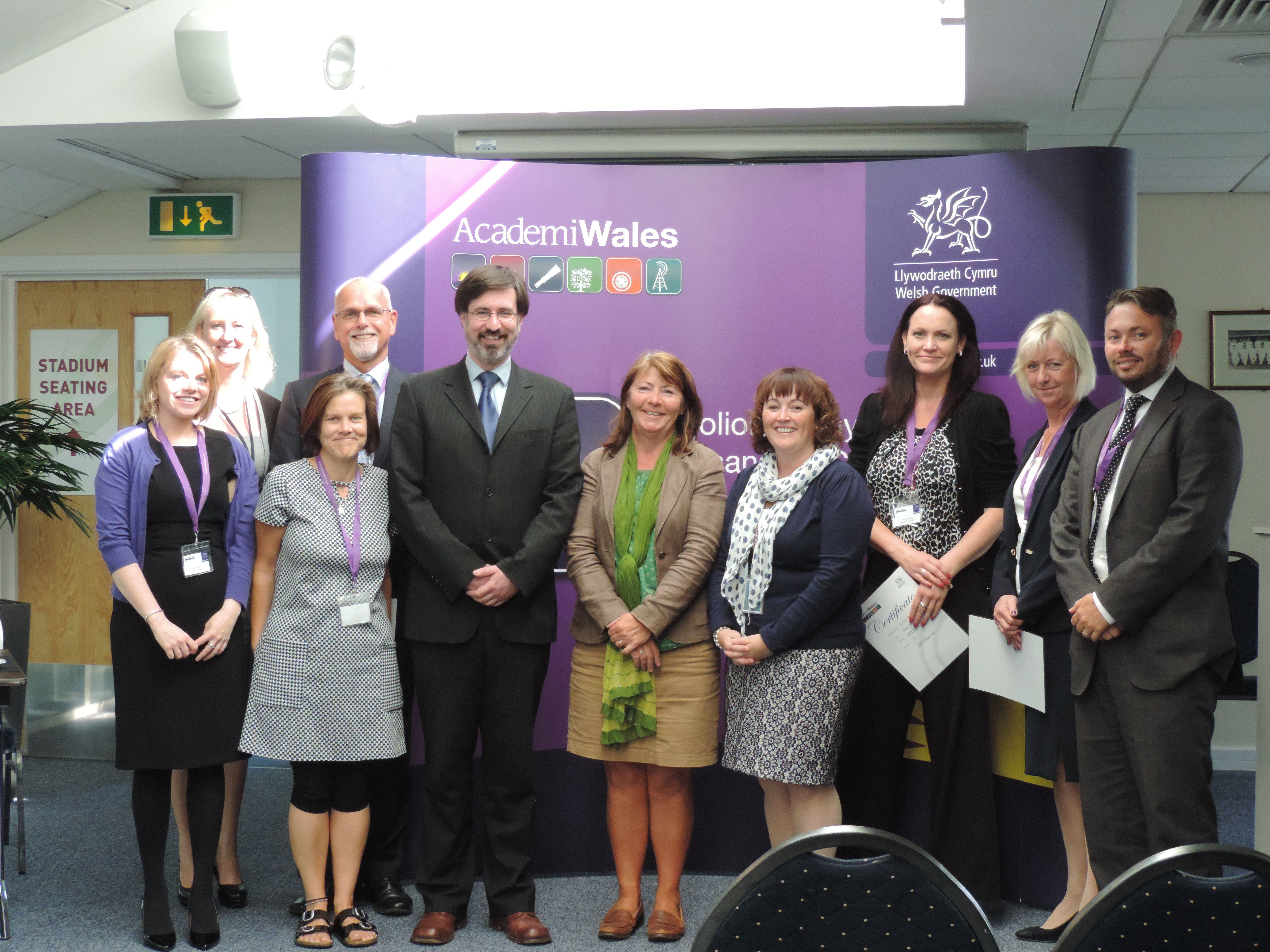
    On Monday I was in Cardiff for a celebratory lunch, hosted by Academi Wales, to recognise the achievement of graduates from the PgCert Public Services Governance programme. Below is a copy of my talk:


    Public Services Governance – Graduation

    Thank you to Academi Wales for inviting me to give this short talk. It’s great to be in Cardiff again and once again the sun is shining. And what a terrific venue for this celebratory lunch. It really is wonderful to see you all again. You should be really proud of what you have all achieved – seriously, well done!

    I have been asked to give a short talk on how the partnership was established, how students progressed through the programme and then finish by discussing what happens next.

    When I started to think about this talk and what I would say one thing came to my mind immediately – that the more things change the more they stay the same.

    On 19th September it looks increasingly likely that the UK Government will be entering into negotiations with the Scottish Government about the progress of establishing an independent Scotland. This may seem like a revolutionary moment. Yet many things will remain the same. The EU will still exist, the UN, the World Bank and the global money markets. And the Scottish Government and rest of UK Government will continue to operate within this global context.

    But of course there will be some change. And it is at times of change that I believe the need for good governance becomes even more critical.

    I feel that Academi Wales have shown great foresight, and indeed courage, in investing in public service workers from across Wales to undertake this programme. And you are very fortunate to have had that opportunity.

    It was back in July 2012 that I got the first call from Academi Wales that they were interested in sponsoring some students on the programme. Following that a value for money exercise was conducted from which we were, I believe, 3rd out of a possible 90 suppliers. But more than that, Academi Wales felt that our programme, the first of its kind in the UK, was the most contemporary and relevant to public services workers in Wales.

    So in December that year I came to Cardiff to the Welsh Government offices where we, along with Prof Catherine Farrell from the then University of Glamorgan, jointly discussed and agreed the detailed structure and content of the programme. This was to include four modules: public services governance themes and issues, public finance, leading change and internal communications. These were seen to be most relevant to those working in a post-Williams Review Wales.

    Then, in April 2013, I came to deliver the two days of module delivery on the first module. On meeting the students I was immediately struck by their enthusiasm and commitment to the programme. That said I can’t say I was surprised, as we’ve always had excellent students on our public services programmes. This is, more than anything, what makes my job so worthwhile. Sharing ideas and practice with experienced and skilled public service workers. It really is an absolute joy.

    Since then the university have established a new masters level programme in public services leadership. This programme draws on many of the aspects of governance within the PgCert but with a focus on coaching as a form of leadership. It is a collaborative programme with City of Edinburgh Council, Dundee City Council and Orkney Islands Council and we currently have over 50 students on this programme. Unfortunately Academi Wales are no longer in a position to support any bursaries, due to budget cuts, but students should continue to nurture the relationships that were established in this programme and build new relationships with students and graduates from all of our public services programmes.

    I would like to thank Paula James and Jo Carruthers from Academi Wales, Prof Catherine Farrell from University of South Wales, and my colleagues from QMU for having made this programme work. But most of all I would like to thank you, the former students, for having made this such a positive and fulfilling experience for me.

    Much of the nature of education is about change. It’s about personal change. About challenging your own assumptions and values. About challenging your practice. You may indeed feel that at the end of this programme you’re a different person. Now you are entering a new beginning. Having successfully completed the programme it is now up to you to implement what you have learned and apply those critical thinking skills to inform your practice: to deliver better governance and delivery of public services in Wales.

    But I would also like to remind you that some things won’t change. First and foremost you will always be part of the QMU family. This doesn’t just mean that you’ll get mail from time to time asking you to donate to the university. But you will also get mail from me asking for your views on governance and public services. Your views still matter. At the same time I will still be there. I and the other academics from the public services programmes will always be available to continue sharing ideas and learning. That does not stop just because you have graduated. The learning continues.

    I would encourage you all to maintain and continue to build the relationships that have been built as a result of this programme. Continue to share ideas and learn from each other. Whatever changes the future brings the need for good governance remains constant. As a graduate of this programme you are ideally suited to meet those challenges. I will continue to provide any support I can and will continue to work with Academi Wales and Prof Catherine Farrell as they see fit. I wish you all the very best.

    Thank you.


    Graduates and staff
    Graduates and staff
  • SR2013

    Politics vs Economics

    Less than 24 hours since the Chancellor stood up in Parliament to announce his spending plans for 2015-16 much has already been written about both the style and content of his speech. Needless to say (and despite the Chancellors protestations this morning) this was a highly political speech with the upcoming general election firmly in view. Whoever wins in 2015 will undoubtedly inherit a very different public sector than existed in 2010.

    When analyzing the content of the Chancellor’s statement much has been said about the extent of continued cuts to public service spending. But these levels of cuts were always going to be the case. The current position of our public finances would not allow for anything else. What is more there is little political contention about the need for cuts.

    However, not all public services were cut. Certainly not in equal measure. We can perhaps learn more from what the Chancellor chose to (in relative terms) protect as we can from those things he chose to cut.

    Winners

    In terms of departmental spending international development once again comes out well with a 7.8% increase. Of this is due to international commitments to 0.7% of Gross National Income (GNI). The other big winner is the Single Intelligence Account which goes towards the intelligence services where there is a 3.4% increase. There is also to be a new £1 billion Conflict, Stability and Security Fund under the National Security Council. Finally there is to be £210 million investment in the National Cyber Security Programme (NCSP). In other measures there is to be no further cuts in the number of armed forces personnel and they are to be protected against any changes to progression pay.

    The NHS is also relatively well protected with the Department for Health receiving a 1.9% increase. Although, the administrative budget for the NHS has been cut by over £1bn (a 27.3% cut in administrative costs). Interestingly the government has set aside significant funds to support further transformation in the way our health and social care services are provided. A £3.8bn budget has been allocated to support more integrated health and social services for older and disabled people. They have also ring-fenced £350mn of capital funding for projects to improve local integration including the sharing of patient data between the NHS and local authorities.

    Finally the government has protected the elderly from much of the impact of the cuts. Of particular significance the state pension has been excluded from the new welfare spending cap. Given the ageing population and the pressure this will potentially place on public finances in the future this is an interesting move. The Warm Home Discount will provide £320m for discounts on electricity bills to the least well-off pensioners. The Department for Work and Pensions budget has been cut by 8.8% but most of these cuts will be from the administrative budget which has been cut by 20.3%.

    Losers

    Perhaps the most significant loser in all these cuts is the very group who are charged with implementing these changes – public service workers. Departmental administration budgets have been cut by a further £1.9bn. This means that most departments will have had a total reduction of 40%-50% in the six years from 2010-2016. Pay increases have once again been limited to 1% and automatic progression pay will be abolished in the civil service by 2015-16. It will also be abolished for teachers, become non-contractual and linked to performance for prison officers and also significantly reformed in the health service and police service.

    This is particularly the case in local government which has already lost 32,000 posts in the last quarter of 2012 alone. The Department for Communities and Local Government faces a 28.3% cut in their total departmental budget although much of this is partially offset through capital investment commitments. The local government budget is cut by a further 2.3%. Bodies such as sports and arts organisations, that have previously been reliant on local government support, are likely to face very difficult times particularly given wider cuts to arts and sports funding. The use of charitable trusts, local government charging and National Lottery funding as ways to stymie the impact of these significant cuts. Even at this it is hard to see how local government will continue to deliver their statutory obligations in the context of these additional cuts.

    Implementation

    Whether or not all these changes can be implemented by 2015 remains to be seen. However, the statement of intent is clear. With a further 144,000 public sector jobs to go by 2015-16 the government is radically altering the nature of the UK economy. It is important to remember that public sector pay is already low. Yes, average pay in the public sector is higher than in the private sector. But this negates the fact that public service workers do not do the same work. In fact public service workers are disproportionately employed in professional roles such as doctors, nurses and teachers. When comparing like-with-like the reality appears much more stark. Take, for example, that those with a degree-level qualification get paid 4.1% less in the public sector than in the private sector.

    These public sector professionals are now faced with the challenge of meeting government targets for cuts and efficiencies at the same time as continuing to deliver vital public services. No wonder nurses, teachers and carers are among the most stressed workers. Public service jobs are already tough as I have blogged about here and here. This is about to get even tougher. For employers the challenge will be to continue to attract, train and retain skilled public service workers in the face of such adversity.