Category: Public Services Governance

  • Interview with David Crighton, Master of Public Administration (MPA) student

    Interview with David Crighton, Master of Public Administration (MPA) student

    NB: This was previously published on the QMU Website: http://www.qmu.ac.uk/marketing/press_releases/Interview-with-QMU-postgraduate-student-David-Crighton-MPA.htm

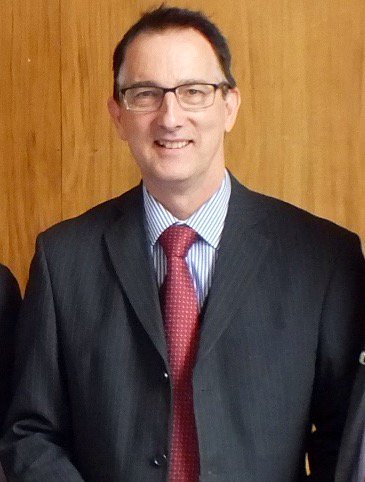
    David Crighton from Glasgow is currently studying the Master of Public Administration (MPA) part-time over two years.

    David has worked within local government for more than 30 years. He started his career as a landscape gardener with Cumbernauld Development Corporation (CDC) in the early 1980s. On completing his apprenticeship, David undertook a series of roles within the CDC before moving to Stirling Council in the mid 90s. In that time, he fulfilled several roles, including Cemeteries Officer and Land Services Team Leader. He gained his first service manager post with Falkirk Council in 2013 before returning to Stirling Council in 2015 and taking on his current role of Roads & Land services manager.

    David has always enjoyed working in the public service especially within an operational capacity. He works towards improving and enhancing the public spaces that are so important to people for health and wellbeing, as well as recreational use and leisure activities. He has a high degree of job satisfaction in the services he manages and the impact they have in improving the quality of life for those that live, work or visit Stirling and its communities.

    Why did you choose to study Master of Public Administration (MPA) at QMU?

    “After undertaking various work based learning and training programmes, I started to develop an interest in management and leadership, preparing for my future career aspirations. I undertook a HNC in Management before moving on to a Diploma in Leadership & Management.

    “The next natural step was to progress to a MBA and had identified this aspiration within my personal development plan. However, I was provided with information on the Master of Public Administration by my employer, Stirling Council, and noticed it aligned more directly to my work in the public sector.

    “I’ve been very fortunate that my employer is very supportive of my learning and has assisted me in gaining a place on QMU’s MPA programme.”

    How do you think the MPA will help you develop your career?

    “Through the MPA, I’m looking to gain a greater knowledge of public administration and to be challenged academically. I’m working full-time and attend the course on a part-time basis, so I do find it difficult at times to manage my work and learning commitments along with my family life.

    “However, there is support amongst my cohort and there are also academic support classes provided at the outset of the course. This has been invaluable to myself have never attended university previously. I think the MPA will help continue my own personal development and ultimate goal of obtaining a postgraduate level degree.”

    Top Tips

    “I would advise any prospective students to be aware of the time commitments especially if you are in full-time employment. It is important to try and build up a support network with library staff, tutors, course leaders and fellow students. This can be important to share your experiences and understand you are not alone.”

    For more information on the Master of Public Administration (MPA) at QMU, visit www.qmu.ac.uk/courses/PGCourse.cfm?c_id=277 and watch our film


  • The Future of Public Administration

    The Future of Public Administration

    Brexit, Trump, Syria, ISIS, Climate Change, Poverty, Immigration, Austerity*, EVERYONE is talking about politics. But when it comes to action it is public service professionals, in central and local government, who are responsible. It is these public officials who have to translate politics into practice and are at the front-line of public service delivery in communities across the UK. That’s why there’s never been a better time to study public administration.

    I’m really excited to have been elected as the new Chair of the JUC Public Administration Committee (PAC). PAC is the UK learned society for education and research in public administration. It’s origins can be traced back to the establishment of the Joint University Council in 1918. For a full history see here: http://journals.sagepub.com/doi/pdf/10.1177/0952076707071500

    The history of the JUC highlights the importance of links with professional bodies, of informing education and training and of representing our institutional members at a national level. As is explained in the above journal article:

    the purpose of the PAC is the promotion, development and coordination of the work of higher education institutions in the pursuit of education, training and research in public administration. (Chapman, 2007: 18)

    As the newly elected Chair of PAC my thoughts are to the future. There is already a huge amount of work coordinated by PAC including, a two-day FREE doctoral conference, funding of seminars and workshops, the annual conference and publication of two outstanding journals: Public Policy and Administration (more here) and Teaching Public Administration (more here). There is also a lot of work in progress on the planning of the JUC Centenary Event. So a large part of my role as Chair will be to support the continuation of all this great work (thanks at this point must go to the former Chair, Professor Howell, and to the continuing Vice-Chairs Janice McMillan, Pete Murphy and Rory Shand as well as the Editors of PPA and TPA).

    In looking to the future I believe we must also grow our membership, diversify our membership and strengthen our links with professional bodies. The critical link with education and training is likely to continue, and indeed may strengthen with the introduction of TEF, but this will always go alongside world-leading research. In short, I believe that PAC can reassert itself as the learned society for public administration in the UK.

    In order to do that I need YOUR help. Are you interested in Public Administration – either as a professional or as an academic? Do you currently run undergraduate or postgraduate programmes in public administration or public management? Are you conducting research in areas related to public administration? If so, click here for more information: http://www.juc.ac.uk/pac/ or email the JUC Secretary: sandraodelljuc at yahoo.co.uk

    And watch this space for future updates!

    References

    Chapman, R.A. 2007. “The Origins of the Joint University Council and the Background to Public Policy and Administration: An Interpretation”. Public Policy and Administration. Vol. 22, No. 1, pp. 7-26.


    *listed in no particular order.

  • The Sustainability of the Scottish Approach to Policy-Making

    The Sustainability of the Scottish Approach to Policy-Making

    The Scottish Approach to Policy-Making involves a focus on: Improvement; Assets; and Co-production. This has been widely written about elsewhere (see here, herehere and here).

    But how was this approach developed? And what does it mean for the implementation of policy (as opposed to policy-making itself)? In other words, is there an equivalent Scottish Approach to Public Administration? And how might this develop in the future?

    In ongoing research I have interviewed ten key players in the development of the Scottish Approach. All are, or were, civil servants within the Scottish Government (previously Scottish Executive). Through this research it is clear that the development of a Scottish Approach to Policy Making was a deliberate move to create a more strategic form of government in Scotland. This involved 1) internal restructuring of the Scottish Government with the establishment of strategic Directors-General and cross-cutting directorates; 2) the development of the National Performance Framework, Scotland Performs; and 3) significant investment in leadership development with a particular focus on Adaptive Leadership and Public Value.

    The rationale for much of this was based on a recognition that the managerial approach to public administration of the 1980’s and 1990’s had not led to a significant improvement in the tackling of ‘wicked issues’ such as child poverty, climate change and health inequality. Importantly, this was linked to a growing recognition that addressing these challenges would require partnership-working across the public sector and beyond. That Government could not solve these problems on it’s own but that they would require a whole-of-society approach.

    Initiatives such as the strengthening of community councils, the community planning partnerships, and the Community Empowerment Act are all part of a shift towards enhancing the role of communities in the design, delivery and ownership of public services.

    Interestingly, the development of the Scottish Approach has been characterised as, in part, a conscious effort to move away from the old approach which was characterised as based on top-down; paternalism; working in silos; acute focus on curing problems after they arise (Mitchell, 2015). Ten years on has anything changed? Is the Scottish Government more strategic? More collaborative? More prevention-focused?

    As noted above a key part of the ‘Scottish Approach’ was a focus on Adaptive Leadership. This is a leadership style developed primarily by Heifetz (his key texts include ‘Leadership on the Line‘ and ‘The Practice of Adaptive Leadership‘). Put simply, Heifetz argues that leaders face technical problems and adaptive challenges. Technical problems have a clear solution whereas adaptive challenges may have multi-faceted causes and require a multi-agency approach. Hence the focus on collaboration and prevention (examples include the Early-Years Collaborative and Health and Social Care Integration). Clearly an adaptive approach has particular relevance in public services in the face of the above mentioned ‘wicked problems’ such as child poverty, climate change and health inequality.

    But can adaptive leadership work in the public sector? My ongoing research is exploring some the challenges in adopting Adaptive Leadership in a public context. In doing so a number of important questions are being raised about the sustainability of the Scottish Approach itself. Undoubtedly there is a solid rationale behind the adoption of adaptive leadership in a public services context. The extent to which this can, or even should, be maintained over time will be uncovered through my research.


  • I Tried to Bribe an Official

    I Tried to Bribe an Official

    Earlier this year I tried to bribe an official. Actually, I didn’t really. But this was how it was construed. The experience made me think a lot about bureaucracy, process, control and leadership.

    It all came about when I was asked to do a presentation at a conference. This was a commercial venture – for which speakers often receive a modest fee. I have never accepted a fee for this type of activity which I believe is part of my job in terms of public engagement. But at the same time I don’t believe I should give my labour for free. So in lieu of a ‘fee’ I received some complementary tickets which I then gave to our postgraduate students. Thereby enhancing their learning experience and indeed hopefully adding to the discussion at the conference itself. A classic win-win I would have thought.

    Here’s where it all starts to unravel. Many of our students are employed by public bodies. One such student, from Anytown Council, mentioned to their boss that they had received a complementary ticket to a conference and would require the day away from the office to attend. At this point it’s important to remember that this was part of the student experience and would directly help the student in her studies – and in turn help in her job.

    The response? The student was asked to complete a business case as to what the conference was about and exactly what the benefit would be for her job. So, instead, the student decided to take the day as annual leave.

    At that point you might think that would be the end of it. Oh no. Next the student was told that this could be construed as a bribe. Yes, the student experience is no longer just about me trying to enhance the learning experience of the students – clearly I might be using this as part of some Machiavellian plot.

    So, said student is sent the 50 page policy document on ‘gifts’ and asked to read carefully. Then, said student has to complete a form (there is always a form). It must be explained what the nature of the gift is, from whom it has been received and what potential conflicts of interest there might be. Meanwhile the public need better public service delivery. Clearly, this doesn’t help.

    These policies and processes exist for good reason. But ultimately how they are interpreted and applied is key. Clearly there is a balance to be struck between following the letter of the policy in a literal and inflexible way vs following the principle of the policy in a proportionate way. Often this requires leadership – to say ‘is this really necessary?’.

    What this story highlights for me is the importance of what we are doing at QMU. Our public services still need better leadership. There is still a long way to go. But I’m confident that through our MPA programme, research and CPD programmes we will help.

  • Connecting with the Real World

    Connecting with the Real World

    I’ve written before about ‘Academics in the Real World‘ and it is an area that continues to attract much attention and debate.

    I was reminded of this recently when discussing ‘student experience’ with the programme leader of our amazing MSc Gastronomy programme (see here for more information). It might seem at face value that this is a very different type of programme from our Master of Public Administration (MPA) programme. Yet the aims and objectives of these two different programmes are remarkably similar. Both have, in line with the Queen Margaret University mission, a core commitment to social justice. And both use practice-based learning to support students’ understanding of ‘the real world’.

    The understanding of how policy and politics affect practice is key to understanding public administration. This is our version of ‘from farm to plate’. We need to understand the origins of policy, how it is interpreted by public service professionals, and the impact this has on individuals and communities.

    Over this first year of the Edinburgh MPA we have been developing our approach to the student experience. A significant part of this is the Workplace Learning module which we have developed in association with ACOSVO to enable all our students to get ‘real world’ experience (see more here). We have also had guest speakers from the UK Civil Service Fast Track, we have attended a conference on Scotland’s Public Sector Workforce and we have visited the Scottish Parliament as shown in the following short film:

    .

    For next year we are planning lots more activities to expose our students to the realities of public service delivery. In doing so it is important that we continue to reflect on both the political process and the impact subsequent policies have on communities.

    In other words, we will always be committed to reflecting and challenging the nature of ‘the real world’.

    If you would like to find out more please sign up for our Open Evening: http://www.qmu.ac.uk/marketing/bulletins/opendays.htm

    Applications are now open for September 2017: http://www.qmu.ac.uk/courses/PGCourse.cfm?c_id=277

  • The Stories We Tell

    The Stories We Tell

    I’ve not been blogging much of late due to a number of other priorities around marking, teaching prep, research writing and conference attendance. In amongst all of that I’ve had three lovely weeks off at the start of August. For many people the summer holidays are a time to catch up with some reading. For me this largely involves Julia Donaldson books. But recently I discovered a new favourite – Yertle the Turtle by Dr Seuss. Here is why it should be required reading in every Business School.

    Yertle the Turtle is a story about a King Turtle, called Yertle, who becomes increasingly power hungry. Not satisfied with his status as King of the pond he requires his subjects to work harder in order to extend his realm. As his status rises so the burden of those below him also increases to the point where they are in great pain and hunger. Yet as Yertle continues to rise high into the clouds his link with those below him becomes ever weaker and ultimately his hubris leads to his demise. It is a fantastic story (available to purchase here: http://www.amazon.co.uk/dp/0007173148).

    This is a children’s book. Like other children’s books the focus is on fair play and the importance of sharing. We constantly tell our children to play nice, to respect others, to always say please and thank-you. When do we think this should stop?

    At some point our childhood learning is dismissed and replaced by mechanisms of management and governance that both enable and actively encourage individualised efforts and game playing. Team-work and shared goals are shunned and often the vision of ‘great man’ leadership is espoused. Even within education group-work for students is often avoided, especially assessed group-work, due to the problems associated with perceived ‘free-riders’. In research sole-authored academic papers are (at least in social sciences) considered superior to co-authored works. In many organisations promotion and reward criteria are often based on individual efforts and evidence of individual impact. Across corporations, and increasingly the public and Third Sectors, this mantra is reflected in the rise of CEO pay packets whilst at the same time tax avoidance and pay restraint for other employees are seen as common and accepted business practice.

    Should Yertle be seen as the villain of the piece or someone to admire – ambitious, assertive and driven? Do we lose something by failing to recognise the value of sharing and team-work in business and management? Or should we tell our children different – to look after number one, that greed is good, to be ruthless in their negotiations and never trust anyone? Would that help them face the realities of life or, dare I say, improve their employability?

    Should we teach our children different – or is it us who could do with a lesson?

    For another example of the stories we tell see this episode of Peppa Pig in relation to debates around Brexit:


  • Something positive

    Something positive

    I’m just back from the Social Policy Association conference in Belfast. It was a great conference with lots of very engaging speakers discussing their latest research. Topics included:

    • Economic and domestic violence
    • Food poverty
    • Young people, precarity and security
    • Pension inequality
    • Taxation and austerity


    There was also a special session organised on ‘the consequences of Brexit’.


    Some of the highlights for me included a plenary session by Kathryn Edin discussing her new book – ‘$2 A Day: Living on Almost Nothing in America‘ and a presentation by Lorenza Antonucci about her new book – ‘Student Lives in Crisis: Deepening inequality in times of austerity‘.


    These are two great books that I would thoroughly recommend. I was going to write some more about both – but you can just buy the books. What’s more, I was trying to come up with something positive to write about following the conference. But, as you can probably guess from some of the topics listed above, this isn’t easy.


    There is much to worry about. And I don’t want to diminish any of that in any way. Global recession, European disintegration, war, terrorism, rising inequality. Yes, it’s all there. But this is not the 1930’s. My dad was born in the 1930’s – and as I sit in a warm, well lit library drinking fresh Americano and type this blog on my notebook using the free Wi-Fi available I’m made all too aware of that. Yes, I do have a privileged position and others aren’t nearly so fortunate. But this still is not the 1930’s. There’s much to feel positive about despite all the worrying news.


    And what can be done with worry anyway? I’m reminded of the Serenity Prayer. I’m not a religious person but I think there is an important message in this – especially in difficult times such as these:

    God grant us the serenity to accept the things we cannot change,
    the courage to change the things we can,
    and the wisdom to know the difference.


    So let’s focus on the things we can change, embrace the opportunities that we have to make change happen, and celebrate the fact that we all can make a difference. Happy Monday!


  • The Emotional Impact of Brexit

    The Emotional Impact of Brexit

    Change is an emotional process. Any change whether personal, organisational or indeed constitutional is likely to feed into our hopes, dreams, anxieties or fears. The extent to which change can be an emotional process is particularly apparent when we are not in control of the change process. So it is for over 48% of the UK population including 62% of the Scottish population after the vote to leave the EU last Thursday.


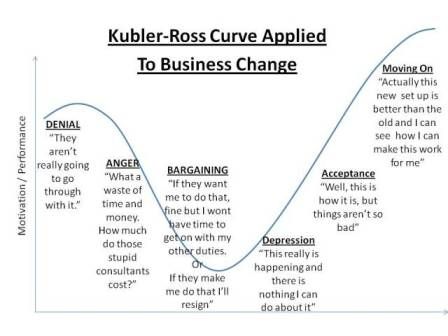
    The nature of the emotional impact of change has been characterised by Kübler-Ross in her Grief Cycle which was originally established to reflect the nature of the grieving process. There have been many versions of the original Grief Cycle created since. One such version is listed below for reference:

    b3f8bf48017cacda49078b6eae94c87f

    Source: https://www.pinterest.com/effard/grief-cycle-feedback-change-imposed/


    Later research by many organisational behaviour and change management academics has linked this process to the emotional impact of organisational change. We can also see how, over the last few days, this Grief Cycle reflects many of the emotions that have been felt by the electorate and how this can help explain (admittedly to a small extent) the events that have happened since.


    Denial:

    This isn’t really happening. There can be another referendum (see here and here). Maybe Scotland can stop it from happening (see here). Maybe there should be another election which will stop it (see here).


    Anger:

    Why is this happening? It’s all the fault of old people. It’s all the fault of poor people. It’s all the fault of uneducated people. See here, here and here.


    Bargaining:

    Maybe I’ll emigrate to Canada / Australia / New Zealand / France. Maybe I’ll get an Irish passport (see here and here). Maybe we can delay it for two or three years (see here). If that’s what’s happening I’m going to resign (as with Prime Minister, Labour MP’s etc).


    Depression:

    There’s really nothing I can do.


    Acceptance:

    OK, it really is happening. There’s no point whining about it anymore – we’ve just got to get on with it.


    Move on:

    There may be opportunities here. Let’s work with others to make the most of things.


    What next?

    It is best not to make significant decisions immediately following and in response to any significant change event. Those who have remained fairly silent over the weekend have undoubtedly done the right thing in taking time to reflect and analyse the situation before making any major steps. It is important that the electorate and markets are given every possible reassurance and that they are supported through this emotional process. All the announcements so far from the UK Government have rightly been about stability and reassurance.


    It is important to recognise that this is an emotional process. That’s not to say that all that has happened, and all that will happen, can be explained by the Grief Cycle. That would be far too simplistic. All I would argue is that it provides part of a wider picture of what is happening right now – and that it is an important part of the picture that should be recognised in moving forward.


    What is needed now is strong but emotionally intelligent leadership. The transitions cannot be rushed. But the sooner that the electorate, and our elected representatives, accept the new reality and begin to move on the better.

  • Leading Change in Public Services – Abstracts

    Leading Change in Public Services – Abstracts

    In advance of the research colloquium on Friday 13 May I thought I would share the abstracts from our speakers. Further information on the event can be found here: https://www.eventbrite.com/e/leading-change-in-public-services-tickets-24921644309


    Dr Rory Shand and Frank Carr, “Plus ca Reform: Rapid change and rapid decay in Public Sector Management“.

    Dr Bobby Mackie, “Talent Management in Scotland’s Public Services: Implications for Leadership Development“.

    Dr Ian C Elliott, Helen Dawson & Prof Paul Joyce, “Leading Change in Public Services Through Redesigning Public Governance Institutions: The Role of Leadership“.

    Prof Paul Cairney, “The Scottish Approach to Policy Making and Implications for Public Service Delivery“.

    Peter Murphy, “A progress report on proposals for greater collaboration between the blue light emergency services and the involvement of Police and Crime Commissioners in the governance of Fire and Rescue Services in England“.

    Prof Jari Stenvall, Dr Tony Kinder, Dr Ilpo Laitinen, & Dr Päivikki Kuoppakangas, “Dilemmas and unlearning – the case of big data“.

    Prof William Webster, Prof Douglas Robertson & Charles Leleux, “SmartGov’ Smart Governance of Sustainable Cities: Citizen Engagement, ICTs and Sustainable Urban Development in the United Kingdom, The Netherlands, and Brazil“.

    Dr David McGuire, “Sexual Orientation in the Public Sector: Issues of Inclusion and Identity in the Workplace“.

  • Leading Change is Full of Nonsense

    Leading Change is Full of Nonsense

    There is nothing constant except change

    Be the change you want to see in the world

    Take a look at yourself and make the change

    So much of leading change is full of management-speak, lazy slogans and corporate bull$¬!£. As if an oxymoron is the most effective use of the English language to sum up an entire field of study.

    This is why I was keen to have Steve Toft speak at our colloquium on Leading Change in Public Services. Steve writes the very influential blog FlipChartFairyTales which has as it’s strapline “Business Bullshit, Corporate Crap and other stuff from the World of Work”. I’m also delighted that Dave Watson, Head of Policy & Public Affairs at UNISON Scotland, will be speaking at our colloquium (his blog is here). Both are not shy when it comes to asking tough questions and both are adept in their use of evidence to support their analysis.

    These two ‘industry-based’ speakers will be joined by a number of academic researchers who will be presenting their latest research on issues related to the topic of change in public services.

    This critical academic debate is really needed. Sadly, I feel at times that analysis and evidence-based analysis are lacking when it comes to the subject of leading change. Just browse the titles of the many self-help management books that grace the shelves of every bland airport bookshop around the world. It would seem at times that there’s an entire industry of consultants and pracademics churning out clichés designed to inform ‘better’ management and self-actualisation. The titles could almost write themselves: 10 Easy Steps to Success; Think Positive; A Short Guide to Successful Change; How to Influence Change in 10 Seconds. If only it were that simple (NB: I made those titles up for illustrative purposes. Apologies to anyone who’s actually written a book with one of those titles).

    The trouble is that organisational change requires people change. And people are complex, emotional, unpredictable, political, gendered, cultural beings. So any organisational change will as a result also be complex, emotional, unpredictable, political, gendered and cultural. Unless we recognise that we are likely to fail – is it any wonder that, according to John Kotter, more than 70% of change efforts fail?

    Add to that mix the nature of public services (see here and here). What do I mean? Well, public services are often inherently complex and targeted at some of the most vulnerable groups in society. So there is a great risk, sometimes life-threatening, if things go wrong. Also, it’s public money so everyone has an opinion, everyone has a stake, and everyone is just waiting for something to go wrong. And of course Politicians also have an important role to play in our public services. Yet even in the more robust academic texts on leading change the distinctive nature of public service change tends to be overlooked.

    It appears that anyone wanting to offer advice is best served by offering a simple model with an equally simplistic, yet catchy, acronym. This, it would seem, is what sells. Not complexity, not more questions, and certainly not theory (as we know academics don’t exist in the real world).

    That’s not to say that there are excellent books out there on the subject of leading change in public services – there are actually quite a few (which I won’t list here for fear of forgetting someone). Equally the ‘generic’ organisational change texts are of course hugely valuable – to anyone. But I think there is still an important place for continued critical debate around leading change in public services. This is why I have organised this one day research colloquium: https://www.eventbrite.com/e/leading-change-in-public-services-tickets-24921644309